The 2026 Amendment to the Transgender Persons (Protection of Rights) Act has effectively gutted the soul of trans dignity in India: the right to self-identification.
This move stands in direct defiance of the landmark 2014 NALSA v. Union of India verdict, in which the Supreme Court of India ruled that the individual—and only the individual—is the sovereign authority over their own gender. Today, that sovereignty is being subdued by a state that treats legal history as something that can be undone with a single signature.
The scale is staggering. While the 2011 Census officially recorded 4.87 lakh transgender individuals, the National AIDS Control Organisation and community advocates estimate the actual figure is closer to one crore. By replacing self-identification with a medical tribunal, the state is attempting to funnel millions of diverse lives through a single clinical needle—a bureaucratic bottleneck designed to exhaust a population into invisibility.
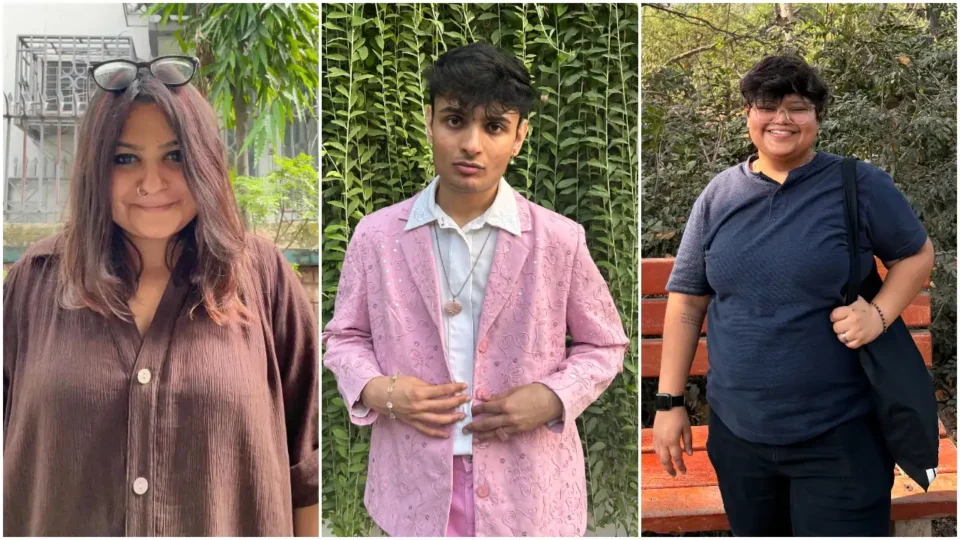
For Priyadarshini, a 29-year-old non-binary femme lesbian brand manager, and gender and sexual rights activist in Kolkata, the speed of the legislation felt like a physical strike. “The bill came to the floor of the lower house—passed amidst opposition—and within a week it went to the upper house, and the President gave it an assent,” she recalls. Priyadarshini, who has spent years balancing a corporate career with front-line advocacy, sees the timing as a deliberate tactic of exhaustion.
“By 11 o’clock at night, we start hearing things, and by the very next morning, there’s a gazetted copy. If our government really works so fast, why does our country have so many issues?” She says wearily, “It feels like they are moving under the cover of night to overwrite our humanity before we can even organise a response. How can the legislature go against what the Supreme Court has already said?”
The intrusion of the cis gaze
The ‘audacity’ at the heart of this crisis doesn’t belong to the protestors screaming in the streets— it belongs to the architects of this erasure. There is a grotesque irony in watching a room of cisgender politicians legislate the boundaries of trans existence.
“Imagine a stranger, who has never lived a day in your skin, deciding if you are `real` enough to exist in the eyes of the law. It is a profound violation to have your truth treated as a debatable topic by people who have no skin in the game,” counters Priyadarshini.
This is the institutionalisation of the ‘cis gaze’—the state’s declaration that an internal truth is a mere suggestion, while a clinical observation is the absolute fact. When laws are built on the assumptions of those who have never navigated the vulnerabilities of gender nonconformity, the result is a framework of indifference. By reversing the burden of proof, the Act forces trans individuals to justify their existence to a committee of cisgender strangers, transforming a birthright into a medical permit.
“It forces my trans siblings to stand before a medical board, to potentially strip, to be `assessed` by people who have likely never read the NALSA judgment. We are being told to wait for a stranger’s verdict on our own identity. This amendment is fundamentally broken,” she insists.
The clinical weapon: Assessment as assault
The amendment introduces a mandatory ‘District Screening Committee’ and a medical verification process for anyone seeking a gender certificate. This isn’t just a new layer of red tape—it is a psychological siege. Adityuh, a 24-year-old trans-masculine psychology student and community support worker in Delhi, views the move as state-sponsored gaslighting.
“Identity isn`t something you prove; it’s something you are,” they say. This clinical turn is particularly harrowing given the existing healthcare landscape. According to a report by the National Human Rights Commission, roughly 92 per cent of transgender people in India are deprived of the right to participate in any form of economic activity, due to institutional discrimination.
For Adityuh, the hospital—a place that should theoretically be a sanctuary of healing—is being repurposed. “When I think of a hospital now, I don`t think of care. I think of trauma and doctors with God complexes who treat you like a fascinating specimen,” they recoil.
Under the 2026 amendment, the clinic is transformed into an outpost of the police station—a site for reporting and verification. The white coat becomes a uniform of the state. “The state is saying, ‘We’ll let you live, provided you transition on our terms’. But who is ensuring that process isn`t a nightmare? Trans individuals are treated with blatant transphobia by the very staff supposed to `verify` us,” Adityuh questions.
A safety net in flames
Beyond the individual struggle for a piece of identification, the Act threatens the informal support systems the community has spent decades weaving together. In India, where traditional family structures often reject queer children, the ‘chosen family’ or the Gharana system has been a literal life-saver. Rio, a 25-year-old trans-masculine non-binary corporate professional and community advocate in Delhi, points to the calculated vagueness of the amendment as a tool for systemic erasure.
“The language here is a trap,” Rio elaborates. “By making self-identification illegal and requiring `medical proof` for legal recognition, the bill endangers the safe homes, the NGOs, and even the families who choose to stand by us. If you aren`t legally recognised, anyone harbouring you could be accused of kidnapping or enticing a minor, even if you are an adult.”
Rio, the primary earner for their family, faces a terrifying paradox. Even their supportive mother now lives in terror, “My mom told me, `Don`t leave me if you are thinking of doing that.` The government criminalises her with the kind of vague language it brings into action. That fear is now a permanent resident in our home.”This ambiguity systematically abolishes the support systems that have historically buffered trans individuals from homelessness and violence. “I fear what’s next—will they take my citizenship? My right to breathe?” he admits. “The government isn`t just targeting my wallet or my job; it`s targeting my right to a family. We are being watched, and our right to associate is being strangled.”
The ideal citizen and the margins
The violence of this legislation is not distributed equally. A recurring theme in these conversations is the intersection of caste and class. The Act appears designed to protect a very specific, sanitised image of the Indian citizen—one that has no room for those on the periphery.
“The blueprint for the `ideal` citizen under the current regime is clear: upper-caste, Hindu, cisgender, heterosexual male,” Priyadarshini notes, acknowledging that while the law targets the entire community, the blow falls heaviest on those already pushed to the furthest margins.
“I’ve been able to navigate certain spaces because I have the privilege of education. But for a Dalit trans woman in a rural village, or a Hijra elder who has never owned a birth certificate, this law is an invisible wall. It isn’t just transphobic; it is classist and casteist to its core,” she points out.
The data support this grim reality. The 2011 Census noted that the literacy rate among the trans community was only 46 per cent, far below the national average.
For those already on the margins, a law requiring complex documentation and medical proof is essentially an expulsion order. The state counts on this exhaustion.
As Adityuh puts it, “The state knows that if they make life hard enough, eventually, we might just stop fighting.”
The audacity of vocabulary
Despite what Priyadarshini terms a ‘death warrant,’ the community finds its strength in the very vocabulary the state seeks to regulate. For many, finding the right words for themselves wasn`t about a label—it was about finding a map home. In a society that often uses ‘transgender’ as a catch-all for anything outside the binary, the nuance of modern identity is a shield.
“When you finally find the word that defines you—whether it`s non-binary, genderqueer, or trans-femme—it feels like oxygen,” Priyadarshini reveals. She recalls how meeting a non-binary person for the first time in Brighton changed her life: “Growing up, I never thought of myself as a man… Then I met a non-binary person. That one conversation changed my life.”
Adityuh finds a similar power in bridging the gap between their identity and their mother tongue. “There’s always been a disconnect with me and my mother tongue, Hindi, because there were not a lot of instances where I could really explain… this is exactly how I feel, and there is a terminology for it,” they observe. In the face of systemic erasure, this vocabulary isn`t just a label—it`s a refusal to be edited out. For Adityuh, this reclamation is the foundation of their survival.
“Identity, for us, has always been synonymous with resilience. We’ve had to invent ourselves because the world didn`t have a space for us,” they reflect. The long road ahead
As India moves further into 2026, the trans community faces a threshold of survival. Compounding the fear of the Amendment is the government’s recent legislative pivot toward re-examining the nuances of Section 377. After the 2018 decriminalisation, many now fear a stifling return to criminalisation under the guise of new morality frameworks.
The Act envisions a nation where everybody is standardised, categorised, and controlled. The community isn`t just fighting for labels—they are fighting to exist without being vetted by those whose lives are entirely unimpacted by the laws they sign.
“This is a signal,” Priyadarshini concludes. “Bodies that don`t fit the mould are being told to vanish. But even a minority of one has a truth that no gazette can erase. I will keep fighting for a world where we don’t have to beg for our humanity from an apathetic state. We are not asking for a favour; we are reclaiming what was always ours.”
The protests continue. While the rest of the country sleeps under the ‘protection’ of these laws, the trans community is awake, rewriting the script, and proving that audacity isn`t just about survival—it`s about the refusal to be erased.
“If you think they won`t come for you because you are `normal,` you’re wrong. Once they finish with us, they will find something `abnormal` about you too,” Rio warns. “We are being treated not as citizens, but as something to be cleared away. Don`t look away.”
Why India’s trans community is bracing for legal redaction